Bring in the Candles
The Dark Day
On May 19, 1780, the sky over New England went dark in the middle of the day. By noon it was black enough to need candles indoors, and many were sure the Day of Judgment had come.
In the Connecticut Council, members began moving to adjourn and go home to meet what they believed was the end. Abraham Davenport of Stamford refused. According to Timothy Dwight, he said the Day of Judgment was either coming or it was not. If it was not, there was no reason to adjourn. If it was, he would rather be found doing his duty. He asked only that candles be brought. They were, and the Council continued its work until the darkness lifted.
Nearly a century later, John Greenleaf Whittier immortalized the moment in his poem Abraham Davenport, first published in The Atlantic Monthly in 1866. You can read it in full on the Stamford Historical Society's page.
Kennedy's Candles
The story outlasted Whittier and eventually reached the campaign trail.
While campaigning for president in Charlotte, North Carolina, on September 17, 1960, John F. Kennedy reached back to Abraham Davenport. In remarks preserved by the John F. Kennedy Presidential Library, he retold the story of legislators clamoring to adjourn before what they believed was the end of the world. Then he quoted Davenport rising to silence them:
"The day of judgment is either approaching or it is not. If it is not, there is no cause for adjournment. If it is, I choose to be found doing my duty. I wish, therefore, that candles may be brought."
Kennedy then made the parallel his own:
"I hope in a dark and uncertain period in our own country that we, too, may bring candles to help light our country's way."
Like many stories passed down over generations, Kennedy told it a little loosely. He described the darkness as a storm, placed the event around the time of the Constitutional Convention rather than in 1780, and made Davenport Speaker of the Connecticut House instead of a member of the Connecticut Council. But the heart of the story remained intact. Nearly two centuries later, a man asking the country to keep working through uncertainty reached for the same candles. (Source: John F. Kennedy, "Remarks at the Coliseum, Charlotte, North Carolina," September 17, 1960, John F. Kennedy Presidential Library and Museum: https://www.jfklibrary.org/archives/other-resources/john-f-kennedy-speeches/charlotte-nc-19600917)
Shedding Light on the Dark Day
My dad loved this story. Throughout most of my childhood, he insisted the darkness had been an eclipse, so every eclipse became an excuse to bring up Abraham Davenport and the candles. It became one of his dependable jokes—the kind you can see coming a mile away and still laugh at anyway.
The eclipse, however, is the one explanation that does not hold up. By 1780, astronomers could predict eclipses years in advance, down to the hour, so an eclipse would have been expected rather than mistaken for Judgment. An eclipse is also brief and occurs only during a new moon, while the Dark Day lasted from late morning into the following night, when the moon reportedly rose red.
The most likely explanation, identified much later through tree-ring research, is that smoke from enormous forest fires to the northwest combined with fog and low clouds to block much of the sunlight. Reading that explanation today, as wildfire smoke has once again darkened skies across North America, makes the story feel unexpectedly modern. The candles, it turns out, were never just about the eighteenth century.
For those interested in the research, see William R. Botkin et al., "The Cause of the Dark Day of 19 May 1780," Canadian Journal of Forest Research 31, no. 2 (2001), available through the USDA Forest Service: https://research.fs.usda.gov/treesearch/41025.
A Modern Take
The story stopped being only history for me when I was in high school at Trinity Episcopal School in Richmond. We lost several days to bad weather and power outages.
My dad, never one to waste a good parallel, emailed my advisor (conveniently, a family friend who appreciated his sense of humor) with a link to the story of Abraham Davenport. He suggested that we should all simply bring out our candles, like Abraham, and get back to learning.
My advisor replied, laughing, that this was undoubtedly a fire hazard and definitely not something the school would approve in 2008.
Imagine being the one student whose father was lobbying against the snow day while everyone else was already mentally sledding.
He was undeterred, because that was never really the point. The point was that the work was still there to be done, candles or no candles.
What Martha Saw
My grandmother, Martha (Orr) Davenport, was no stranger to hard work herself. She met my grandfather, Warwick, at UVA in the 1930s. He was in law school, and she was earning a master's degree in English literature, decades before the University admitted women as undergraduates.
When she said that the defining characteristic she noticed in the Davenports was a plain, steady willingness to keep working, she spoke from experience. She often remarked that she was impressed by how Abraham's legacy of hard work and meaningful service to society was still very much alive in later generations.
That, more than the darkness itself, is the family story I inherited. The candles matter because they symbolize a simple idea: when the world grows uncertain, you keep doing the work in front of you. Whether told by a nineteenth-century poet, invoked by a presidential candidate, joked about by my father, or recognized by my grandmother, the lesson remains the same.
Bring in the candles.
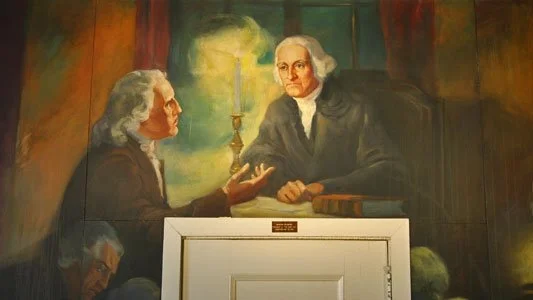
Dark Day (1934), a mural by Stamford artist Delos Palmer depicting Abraham Davenport before Governor Jonathan Trumbull during the Dark Day of May 19, 1780. Commissioned through the W.P.A. federal art program and painted for the courtroom of the Old Town Hall on Atlantic Street, Stamford, Connecticut. Photograph by Steve Castagneto, Academy of Information Technology, Stamford. Courtesy of the Stamford Historical Society.