The Honest Record
Across both family lines, the historical record preserves acts of conscience, intellectual ambition, public service, and participation in systems that should not be romanticized. Some ancestors challenged the world they inherited. Others helped build it. The point is not to celebrate every ancestor. It is to understand them honestly.
★ ★ ★
When I first began researching this family, I was looking for someone to redeem it.
For a long time, I wanted a clean answer. I wanted to know whether I should feel pride or shame. The records refused to cooperate.
The family tree contains founders, ministers, educators, soldiers, judges, merchants, planters, enslavers, reformers, and abolitionists. It includes people who helped build institutions that still exist today and people who benefited from colonization and slavery.
The same family that produced Robert "King" Carter, one of the wealthiest slaveholders in colonial Virginia, also produced Robert Carter III, who freed 452 enslaved people in the largest private emancipation in American history before the Civil War. The same New England families who valued literacy, education, and religious conviction also participated in the colonization of Native lands.
Eventually I concluded I had to stop looking for a clean verdict.
History is allowed to be complicated. Families are allowed to be complicated. The people who came before us were not characters in a morality play. They were human beings: admirable in some moments, troubling in others, and often both at the same time.
The goal of this page is not to celebrate every ancestor or condemn every ancestor. It is simply to tell the truth as best I can find it.
The Systems They Inherited
★ ★ ★
Robert “King” Carter
Robert "King" Carter became the wealthiest man in colonial Virginia and one of the most powerful figures in the colony's history. At his death he controlled vast landholdings and hundreds of enslaved people.
The prosperity inherited by later generations of this family did not emerge in isolation. It was built within a colonial plantation system that concentrated land, wealth, and political power while denying freedom to others.
King Carter belongs in this history not because he was admirable by modern standards, but because he was consequential. The opportunities enjoyed by later generations cannot be separated from the world he helped build.
Colonization and New England
The New England branches of the family participated in the settlement and expansion of English colonies that permanently transformed the region.
Those colonies created churches, schools, towns, and institutions that endure to this day. They also displaced Native communities and became involved in conflicts whose consequences extended far beyond their own generation.
The same religious culture that helped inspire literacy, education, and eventually institutions such as Yale also existed within a colonial framework that reshaped an entire continent.
An honest account of the family's past must acknowledge both realities.
The record preserves both.
Conscience and Character
★ ★ ★
Samuel Sewall
Samuel Sewall participated in one of the darkest episodes in colonial New England: the Salem Witch Trials.
He was also the only judge who later publicly accepted responsibility for his role.
Five years after the trials, he stood before his congregation while a written confession was read aloud. Later, he published The Selling of Joseph, one of the earliest anti-slavery pamphlets in British North America, despite public criticism.
His significance is not that he was always right. It is that he publicly admitted when he had been wrong.
Credit: Samuel Sewall, The Selling of Joseph, Boston, 1700. The only surviving original is held by the Massachusetts Historical Society.
Robert Carter III
Robert Carter III inherited wealth, status, and influence from one of Virginia's most powerful slaveholding families.
In 1791 he filed the Deed of Gift, arranging for the gradual emancipation of 452 enslaved people, the largest private emancipation in American history before the Civil War.
What makes the act remarkable is not simply the number of people freed. It is that it came from within the very family that had benefited most from the system itself.
Credit: Robert Carter III's Deed of Gift, 1791. Courtesy of Nomini Hall Slave Legacy, via Encyclopedia Virginia.
Thomas Stanton
Thomas Stanton spent much of his life serving as an interpreter and intermediary between English settlers and Native nations in southern New England.
No one living in the seventeenth century escaped the realities of colonization. Yet contemporaries repeatedly described Stanton as fair, reliable, and trusted by people on both sides.
His story is a reminder that conscience often operates within imperfect systems rather than outside them.
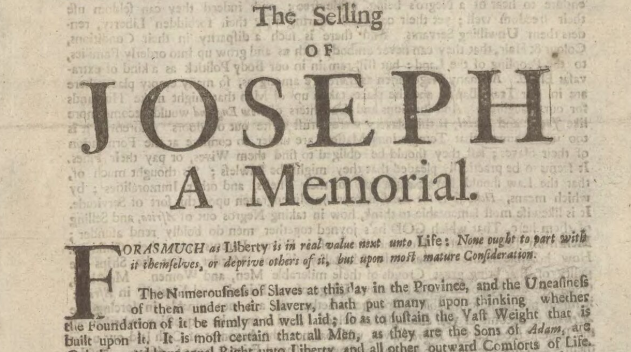
“Liberty is in real value next unto Life: None ought to part with it themselves, or deprive others of it, but upon the most mature Consideration”
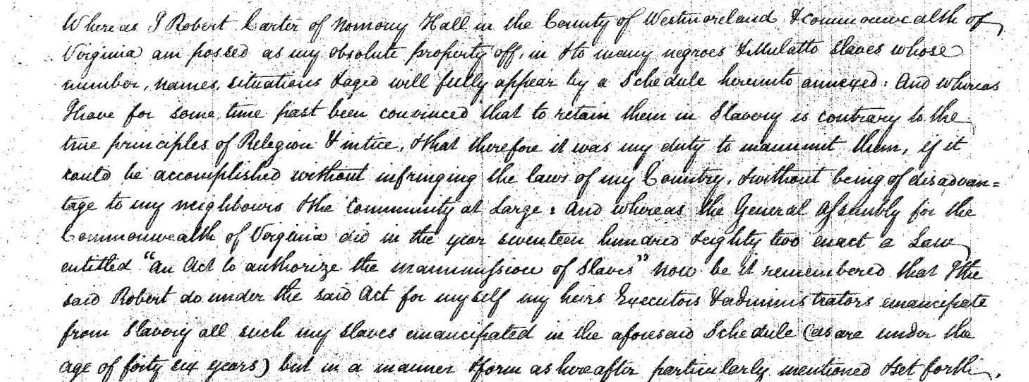
“And whereas I have for some time past been convinced that to retain them in Slavery is contrary to the true principles of Religion & justice, & that therefore it was my duty to manumit them …”
The Record Speaks for Itself
William Byrd II Writes It All Down
William Byrd II kept a private diary in shorthand, never expecting it to be published.
When historians eventually decoded it, they found a man who recorded his reading, exercise, social ambitions, family life, and the routine violence he inflicted on enslaved people in the same matter-of-fact tone.
The diary remains one of the most important firsthand records of colonial Virginia because it refuses to flatter its author.
"I said my prayers and had good thoughts, good health, and good humor, thanks be to God Almighty."
A line that closes nearly every entry—and becomes more complicated with each page.
The Silences in the Record
The historical record is not neutral.
Most family histories are built from the documents men were more likely to leave behind: military service, public office, church leadership, property records, published diaries, and institutional histories.
Women often appear only as daughters, wives, mothers, and connections between family lines.
That does not mean they were less important. It means the record preserved different things.
Many of the values that recur throughout this family history—education, faith, resilience, curiosity, and devotion to family—were transmitted within households long before they appeared in public institutions.
Sometimes enough letters survive to let us glimpse one of those lives. One such story is that of Margaret Elizabeth (Bradfute) Warwick, whose experience of loss during the Civil War inspired the essay What She Carried.
While researching her life, I found myself thinking less about the causes for which people fought and more about the things that transcend them.
A mother's grief transcends Confederate and Union.
Love transcends politics.
Loss transcends ideology.
Those human experiences remain recognizable no matter which side of history we imagine ourselves standing on.
What Remains
No family tree this old is morally simple.
When I first began researching this family, I wanted a clean answer. Instead, I found something messier—and, ultimately, more interesting.
The deeper I went, the more I found stories that resisted simple categories: a judge who publicly repented, the grandson of a slaveholder who became an emancipator, a mother whose grief transcends every side we imagine ourselves to be on.
History is allowed to be complicated. Families are allowed to be complicated.
The people who came before us were not entirely heroes or entirely villains. Most were neither. They were human beings trying, succeeding, failing, believing, loving, and leaving behind traces of themselves for us to find.
We do not inherit only the parts that make us proud, nor only the parts that make us uncomfortable. We inherit the whole messy, beautiful, complicated thing.
The work is not to simplify it. The work is to carry it honestly—to keep saying the names and to keep telling the truth.
That, too, is a kind of inheritance.
Postscript
A Second Byrd Diary
There is a strange symmetry worth noting. William Byrd's diary, above, was kept in secret, and it earned its secrecy.
A second Byrd diary, attributed to Admiral Richard Evelyn Byrd (namesake of the Richmond Airport), has circulated on conspiracy forums since the 1970s, purporting to record a flight into a hidden world at the North Pole. The diary describes a temperate land beyond the ice, complete with lush greenery, mammoths, and a city of giants, none of which is there. It is not real. The Admiral's actual papers are held at Ohio State. So the record stands at one diary meant to be secret that earned it, and one meant to be public that never existed at all. Make of that what you will.