FAMILY LEGACIES
Religious, Secular, and Military Leadership
From The Reverend John Davenport's theocracy to the Great Awakening · 400 years of American religious, civic, and military life
RELIGIOUS LEGACIES ★ CIVIC LEGACIES ★ EDUCATIONAL LEGACIES ★ NOTABLE CONNECTIONS ★ MILITARY LEGACIES
RELIGIOUS LEGACIES
Theologians & Religious Figures
The Rev. John Davenport
(1597–1670)
One of the most prominent Puritan ministers of 17th-century England and New England. Co-founded New Haven Colony; theologian of national influence; envisioned Yale College. Fled Archbishop Laud's crackdown; spent years in Amsterdam exile before founding his ideal godly community in Connecticut.
Richard Mather
(1596–1669)
Patriarch of the most famous Puritan clerical dynasty in America. Principal author of the Bay Psalm Book (1640), the first book printed in British North America. Grandfather of Cotton Mather.
The Rev. Solomon Stoddard
(1643–1729) · Harvard 1662
Minister at Northampton for over 55 years, so dominant in Connecticut River Valley religious life that he was called "the Pope of the Connecticut Valley." Early Harvard librarian. Grandfather of Jonathan Edwards.
Jonathan Edwards
(1703–1758) · Collateral Relative · Yale 1720
The most influential theologian in American history; architect of the Great Awakening. Not a direct ancestor; the younger brother of direct ancestor Elizabeth Edwards. Graduated Yale at age 16. Appointed first President of Princeton in 1758; died of a smallpox inoculation just weeks into the role.
Abraham Pierson
(1645–1707) · Collateral Relative · Harvard 1668
First Rector of Yale College (1701–1707). His sister Abigail Pierson married into the Davenport family. Yale's Pierson College is named for him.
CIVIC LEGACIES
Legislators, Governors &
Civic Leaders
Hon. John Davenport
(1752–1830) · Yale 1770
U.S. Congressman from Connecticut (1799–1817); Revolutionary War Major and original member of the Society of the Cincinnati; 20 years in the Connecticut state legislature. One of the longest-serving members of the early American Congress.
Gov. John Leverett
(1616–1679)
Governor of Massachusetts Bay Colony (1673–1679). One of the first colonial governors who had spent the majority of his life in America. A military commander as well as a civic leader.
Gov. Thomas Welles
(~1590–1660)
Multiple-term Governor of Connecticut Colony in the 1650s. Among the original settlers of the colony and a central figure in its founding governance.(~1590–1660)
Acting Gov. Robert “King” Carter
(1663–1732)
Acting Governor of Virginia; Speaker of the House of Burgesses; Treasurer of Virginia. The most powerful planter in colonial Virginia history and the single greatest genealogical hinge point in this tree, connecting the family to two Harrison presidents and Robert E. Lee.
Parliamentary Gov. Richard Bennett
(~1609–1675)
Parliamentary Governor of Virginia (1652–55) during the Interregnum after Charles I's execution. Represented the Puritan presence within Anglican Virginia, an early bridge between the two worlds this family would eventually unite.
The Yale Dynasty & Ivy League Connections
EDUCATIONAL LEGACIES
★ ★ ★
10
Generations of Yale Graduates
4
CENTURIES OF MINISTERS, JURISTS, AND STATESMEN
3
COLLEGE PRESIDENTS AND FOUNDERS (PIERSON, MATHER, LEVERETT)
NAMESAKE
Davenport College at Yale, named for the colony's founder, contains portraits of Major John Davenport (Class of 1770) and his wife, hanging in the Dining Hall. Members of this family can visit Yale today and see their ancestor on the wall.
Ten Consecutive Generations of Yale Graduates
Before Yale existed, this family helped create it.
The connection between the Davenport family and Yale College begins before Yale existed. Over fifty individuals in this extended family network attended Harvard or Yale, spanning from Harvard's earliest decades to the present.
Both Harvard's first treasurer (Herbert Pelham) and Yale's first rector (Abraham Pierson II) are collateral relatives in this tree. The family's connection to Hopkins School in New Haven, one of the oldest schools in America, founded with Davenport's involvement in 1660, predates Yale itself.
Four of Yale's Residential Colleges
Yale's residential college system, established in 1933 and modeled on the colleges of Oxford and Cambridge, is unusual within American higher education. Every Yale undergraduate is assigned to one of fourteen colleges before arriving and belongs to it for all four years. Each is a small community within the university with its own dining hall, library, courtyards, and traditions. Academic life happens across Yale as a whole; residential and social life happens within the college. Four of the fourteen bear the names of people connected closely to this family's ancestral line.
Davenport College is named for Rev. John Davenport (1597–1670), co-founder of New Haven Colony and patriarch of this family's American line (Generation I in the Davenport descent). As noted above, the college's Dining Hall holds portraits of Major John Davenport (Yale 1770, Generation V) and his wife.
A Personal Note from the Editor: My father, Bradfute Warwick Davenport, Jr. (Yale 1969), was a member of Davenport College and Delta Kappa Epsilon during his years at Yale, overlapping with George W. Bush (Yale 1968) in both. He has received two letters from President Bush over the years, one of them written within about two weeks of the September 11th attacks. I have also received a letter from him.
Pierson College is named for Rev. Abraham Pierson II (c. 1646–1707), Yale's founding Rector. His sister Abigail Pierson married John Davenport (Generation II), joining the Pierson and Davenport lines a generation after both men had helped shape New England Congregationalism.
Jonathan Edwards College is named for the theologian (Yale 1720) who was the younger brother of direct ancestor Elizabeth Edwards (1697–1733), and the architect of the First Great Awakening. He served briefly as the first President of Princeton before dying of a smallpox inoculation in 1758. The connection runs through Elizabeth and Jonathan's mother, Esther (Stoddard) Edwards (1672–1771), a direct ancestor of all five brothers.
Timothy Dwight College honors Timothy Dwight IV (1752–1817), eighth President of Yale, along with his kinsman Timothy Dwight V (1828–1916), Yale's twelfth President. Timothy Dwight IV was the grandson of Jonathan Edwards, which makes him a descendant of the same Esther (Stoddard) Edwards through whom this family connects to Jonathan Edwards College. The connection here is also pedagogical: John Alfred Davenport (Generation VI) was educated at the Academy at Greenfield Hill under Timothy Dwight IV in the years before Dwight assumed the Yale presidency.
Of Yale's remaining ten residential colleges, two are named for Connecticut places rather than people: Branford and Saybrook, the latter being Yale's founding location from 1701 to 1716 before the college moved to New Haven under the leadership of Rev. John Davenport (Generation III). Most of the others honor figures to whom this family connects more distantly, typically as sixth- to tenth-degree cousins through the New England side of the tree, or by marriage through the Welles, Leverett, and Salisbury lines. These include Samuel F. B. Morse, Ezra Stiles, Pauli Murray, Benjamin Silliman, Grace Hopper, Benjamin Franklin, and Jonathan Trumbull. The lineages are real, but thin enough that they belong as a footnote rather than as separate entries.
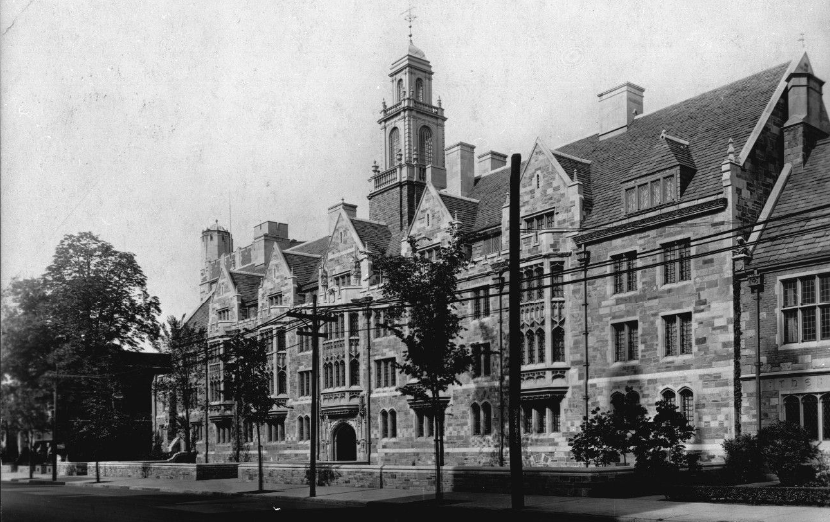
Davenport College, York Street facade, 1931–1933. Davenport College and Pierson College, Yale University, Photographs (RU 600). Manuscripts and Archives, Yale University Library. https://collections.library.yale.edu/catalog/10009425
Yale Graduates & Officers
1701 · Abraham Pierson · Founding Rector of Yale (B.A. Harvard 1668); Fellow 1701-07
1702 · The Rev. Benjamin Woolsey · M.A. 1723
1716 · William Worthington · M.A.
1720 · Jonathan Edwards · B.A., M.A.; Tutor 1724-26; First Great Awakening
1720 · Daniel Edwards · B.A., M.A.; Tutor 1725-28; Steward 1728-34
1732 · The Rev. James Davenport · M.A.; also Princeton 1749
1732 · Hon. Abraham Davenport (Gen IV) · M.A.
1740 · John Worthington · B.A., M.A.; LL.D. 1792; Tutor 1742-43
1741 · Maj. Gen. Jabez Huntington · M.A.
1741 · The Rev. Noah Welles · B.A., M.A.; D.D. Princeton 1774; Tutor 1745-46; Fellow 1774-76
1751 · The Rev. Cotton Mather Smith · M.A.
1759 · The Rev. Ebenezer Grosvenor · M.A.; also Harvard A.M. 1763
1770 · Maj. John Davenport (Gen V) · B.A., M.A.; Tutor 1773-74; U.S. Congressman 1799-1817
1777 · Dr. Benjamin Welles · B.A., M.A. 1780
1783 · Hon. John Cotton Smith · M.A.; LL.D. 1815; Gov. Conn. 1812-17; ex officio Fellow
1784 · Jabez Huntington · B.A., M.A. 1790
1802 · John Alfred Davenport (Gen VI)
1830 · The Rev. James R. Davenport · B.A., M.A.; D.D. Columbia 1878; Tutor 1833-35
1833 · The Rev. John Sidney Davenport (Gen VII) · M.A.
1834 · William Leverett
1855 · William Wheeler · M.A.; LL.B. Harvard 1860
1858 · John D. Wheeler · Sheffield Scientific School
1861 · John A. Davenport · M.A.; M.D. 1863; M.A. (Hon.) 1866
1866 · John Sidney Davenport, Jr. (Gen VIII) · M.A.; LL.B. Harvard Law School 1869
1871 · Russell W. Davenport · Ph.B. (Sheffield); M.A. (Hon.) Harvard 1894, 1898; Instr. Chemistry 1871-72
1887 · John Leverett
1888 · The Rev. Theodore L. Leverett
1891 · The Rev. William J. Leverett
1900 · Edward B. Fackler
1915 · Stephen Rintoul Davenport I
1928 · John Sidney Davenport III and law school
1938 · Bradfute Warwick Davenport
1960 · Huntley Gibson Davenport
1969 · Bradfute Warwick Davenport, Jr. · B.A.
1981 Churchill Gibson Davenport, MFA
? Stephen Rintoul Davenport, III- Honorary Degree: Yale Divinity School
2021 · Atkinson Davenport · M.Div., Yale Divinity School
2022 · Evelyn Nelson · B.A.
2025 · Natalie Keating · B.A.
Harvard Graduates & Officers
1643 · Samuel Mather · A.B., A.M.; Fellow; Tutor
1647 · Nathaniel Mather · A.M.
1656 · Eleazar Mather
1656 · The Rev. Increase Mather · A.B.; A.M. Dublin 1658; Harvard President 1685-1701; Fellow
1662 · The Rev. Solomon Stoddard · A.B., A.M.; Fellow; Tutor; Librarian 1666-72
1664 · Josiah Flynt · A.M.
1668 · Abraham Pierson · B.A.; later Yale Founding Rector
1671 · Hon. Samuel Sewall · A.B., A.M.; Fellow; Tutor; Librarian 1673-74; Chief Justice Mass. Superior Court
1678 · The Rev. Cotton Mather · A.B., A.M.; S.T.D.; Fellow
1680 · John Leverett · A.B., A.M.; S.T.B. (Hon.) 1692; Harvard President 1707/08-1724
1681 · The Rev. James Pierpont · A.M.; Yale co-founder; m. Abigail Davenport
1685 · The Rev. Jonathan Pierpont · A.B., A.M.; Fellow
1687 · The Rev. John Davenport (Gen III) · A.M.; Yale Trustee 1714-31
1689 · Hon. Addington Davenport · A.M. 1712; Just. Superior Court Prov. Mass.
1690 · Warham Mather · A.M.
1691 · The Rev. Timothy Edwards · A.B., A.M. (both same day); pastor East Windsor 1694-1758
1699 · Hon. Edmund Quincy III · A.M.; Just. Superior Court
1707 · The Rev. Joseph Sewall · A.B., A.M.; S.T.D. Glasgow 1731; Fellow 1728-65
1722 · Edmund Quincy IV · A.M.
1779 · Thomas Leverett · A.M.; also Yale 1779
1869 · John Sidney Davenport, Jr. (Gen VIII) · LL.B. Harvard Law School; also Yale B.A. 1866
1988: Stephen Davenport Simrill, J.D. & his wife, Faye- 2018
Sources: Harvard Quinquennial Catalogue 1636–1930; Yale General Catalogue 1701–1924; Dexter's Biographical Sketches of the Graduates of Yale College; Sibley's Biographical Sketches of Graduates of Harvard; Yale Alumni Records.
Key: B.A. and A.B. are Bachelor of Arts (Yale and Harvard usage); M.A. and A.M. are Master of Arts. Ph.B. is the Bachelor of Philosophy granted by Yale's Sheffield Scientific School. LL.B. is the period law degree (modern J.D.); LL.D., D.D., S.T.B., and S.T.D. are usually honorary doctorates. M.Div. is Master of Divinity; M.C. is Member of Congress. Rector was the title of Yale's head before "President" replaced it in 1745; Trustee and Fellow are governing-board roles; Tutor and Steward were resident college officers.
Presidential & Historical Ties
NOTABLE CONNECTIONS
How This Family Connects to History
★ ★ ★
Presidential Connections
Note: None of the individuals below are direct linear ancestors. They are collateral connections through shared common ancestors. All relationships apply equally to all five brothers.
All content is subject to change and is not all proven to a Genealogical Proof Standard.
Thomas Jefferson (3rd President) · 2nd cousins, 6× removed through Mary (Isham) Randolph (Virginia)
John Adams (2nd President) · 3rd cousins, 5× removed through Lucy (Smith) Gardner (New England)
John Quincy Adams (6th President) · 4th cousins, 4× removed through Edmund Quincy (New England)
William Henry Harrison (9th President) · 2nd cousins, 5× removed through Robert Carter I (Virginia)
Benjamin Harrison (23rd President) · 4th cousins, 3× removed through Robert Carter I (Virginia)
Aaron Burr Jr. (Vice President) · 2nd cousins, 5× removed through Esther (Stoddard) Edwards (New England)
John Marshall (Chief Justice) · 3rd cousins, 5× removed through Mary (Isham) Randolph (Virginia)
Robert E. Lee · 2nd cousins, 4× removed through Elizabeth Cooke (Hill) Carter (Virginia)
Benjamin Harrison V (Signer of the Declaration of Independence) · 1st cousins, 6× removed through Robert Carter I (Virginia)
Anne Boleyn · 11th great-grandaunt (collateral) through Ida Louise (Burrows) Warwick
The Carter Hub · William Henry Harrison, Benjamin Harrison (23rd), and Robert E. Lee all trace through Robert "King" Carter, the most morally complex figure in the tree, and its single greatest genealogical hinge point.
What Marguerite Already Knew
Long before genealogical databases existed, Louise Marguerite (Warwick) Davenport (1880–1968) traced her family's descent from Hugh Capet and William the Conqueror by hand, from published genealogies, library collections, and correspondence alone. Her notes map the line generation by generation. She was right. The pathway she identified, through the Capetian kings, Edward III, John of Gaunt, and the Neville family, is precisely what modern sourced genealogy confirms through Warham Horsmanden. That she found this thread at all, without the tools available today, is a testament to both her scholarship and the value she placed on knowing where this family came from.
FEATURED PROJECT
A Byrd’s Eye View
Family history is often preserved through the records men leave behind: military service, public office, church registers, obituaries, property, institutions. But reading through the letters and stories surrounding Bradfute and Barksdale Warwick spurred questions about the woman who outlived them both.
Dive into the story the stories about the same family loss from two different vantage points.
Wars & Military Service
MILITARY LEGACIES
Service across nearly every American war
★ ★ ★
1675
King Philip's War
5 ancestors
1754
French & Indian
Byrd III
1775
Revolution
7+ DAR Patriots
1812
War of 1812
Capt. Rich
1861
Civil War
Bradfute & Barksdale
1941
World War II
Marshall’s Staff
This family has documented military service across virtually every major American conflict from the 1670s through World War II, on both sides of some of them. The record below spans nearly three centuries of service. It is offered here as a family history summary.
Colonial Militia & Early Conflicts (Pre-1675)
Maj. Gen. John Leverett(1616-1679) · Massachusetts Bay militia · Major general in 17th-century colonial wars.
Col. John Carter of Corotoman(ca. 1613-1670) · Lancaster County militia, Virginia.
Capt. James Avery(1621-1700) · New London / Groton militia, Connecticut.
Col. Edmund Quincy(1628-1698) · Suffolk County militia, Massachusetts · Council of Safety figure during the Andros crisis.
Col. Robert "King" Carter(1663-1732) · Lancaster and Northumberland militia, Virginia · Commander-in-chief of the county militias.
Maj. Gen. Daniel Gookin(1612-1687) · Cambridge militia, Massachusetts Bay · Captain of the Cambridge militia; later major general after King Philip's War.
Thomas Stanton(c.1615-1677) · Connecticut colony interpreter · Pequot War veteran, treaty delegate, and longtime colonial interpreter.
Col. William Randolph(1650-1711) · Henrico County militia, Virginia · Lieutenant colonel of militia; later Speaker, Attorney General, and trustee of William & Mary.
Maj. Robert Beverley(c.1635-1687) · Middlesex County militia, Virginia · Major in the militia and active on the governor's side during Bacon's Rebellion.
Capt. James Morgan(1644-1711) · New London Dragoons, Connecticut · Captain of horse and ancestor through both the Avery and Latham lines.
Col. William Beverley(1696-1756) · Augusta and Orange Counties militia, Virginia · County lieutenant and commander-in-chief of the militias in 1741
King Philip's War (1675–76)
Capt. John Gallup(1620/21-1675) · Great Swamp Fight · Killed on December 19, 1675.
Capt. George Denison Sr.(1629-1694) · New England campaigns.
Capt. John Denison(1646-1698) · Stonington militia, Connecticut.
Sgt. John Dickinson(1624-1676) · Hatfield / Hadley troops · KIA at Turner's Falls, May 19, 1676.
Pvt. Samuel Gillett(1643-1676) · Turner's Falls · KIA in the same engagement as John Dickinson.
Robert Stanton(1653-1724) · Capt. George Denison's company, Connecticut · Traditionally identified as the "youthful soldier" at Canonchet's capture.
French & Indian War (1754–63)
Col. William Byrd III (1728-1777) · Virginia provincial forces · Colonel of the 2nd and then 1st Virginia Regiment.
Col. Robert Munford (c.1737-1783/4) · Virginia provincial forces · Served in the Virginia Regiment under William Byrd III.
Latham Avery (1735-1815) · Connecticut provincial troops · Probably served in Capt. Joseph Morgan's company in 1757.
American Revolution (1775–83)
Lt. Col. Francis Otway Byrd(1756–1800) · 3rd Continental Light Dragoons · DAR A010308; officer in the Society of the Cincinnati
Col. Robert Munford(c.1737-1783/4) · Virginia militia · County lieutenant and later commander of several county militias; DAR patriotic service.
Maj. John Davenport(1752-1830) · Continental Army, Commissary Department · DAR A029993; charter member of the Society of the Cincinnati in Connecticut.
Col. Abraham Davenport(1715-1789) · Connecticut militia · Remembered for the Dark Day of 1780.
Rev. Cotton Mather Smith(1730-1806) · Northern Army · Chaplain under Gen. Philip Schuyler, 1775-76.
Lt. Col. Ebenezer Avery I(1704-1780) · 8th Regiment, Connecticut Militia · DAR A003941.
John Leverett(1758-1829) · Naval service, Massachusetts · Captured at sea in 1780; later served as Doctor's Mate on the state sloop Winthrop.
Deacon Samuel Salisbury(1739-1818) · Patriotic Service, Massachusetts · DAR A099280; loaned money to the revolutionary government.
Pvt. Abraham Warwick(1738-1808) · Amherst County militia, Virginia · DAR A121744.
Sgt. William Sidney Warwick(1765-1832) · Virginia state artillery · DAR A121758.
War of 1812
Capt. Stephen Altgelt Rich (1790-1858) · 3rd Regiment Artillery, New York Militia · Commissioned 1st lieutenant in 1812; later captain.
Civil War (1861–65)
◇ Lt. Col. Bradfute Warwick(1839-1862) · 4th Texas Infantry, Hood's Texas Brigade, C.S.A. · Mortally wounded at Gaines's Mill; died in Richmond on July 6, 1862.
◇ Pvt. Barksdale Warwick(1844-1865) · Wise's Brigade, C.S.A. · KIA March 29, 1865, ten days before Appomattox.
World War II (1941–45)
Lt. Col. Bradfute Warwick Davenport (1916–1992) · War Department staff, Washington D.C. · Under Gen. George C. Marshall, 1942–46 · Legion of Merit
Recent/Current Military Involvement
John Davenport, III Descendants:
Sidney Davenport Lord: U.S. Navy: Naval Aviator and flew combat missions in the Persian Gulf during the 1990s
James Stephen Lord, Jr. : U.S. Navy
Byrd Davenport Descendants:
Byrd Warwick Davenport, Jr.: U.S. Marine Corps Reserve
Roswell Davenport Descendants:
Huntley Gibson Davenport, U.S. Army (stationed Fort Campbell, Ky)
John Sidney Davenport, IV: U.S. Army (stationed in Fort Knox, Ky)
Stephen Rintoul Davenport Descendants:
Bradfute Warwick Davenport Descendants:
Bradfute Warwick Davenport, Jr. : U.S. Army (stationed Fort Benjamin Harrison in Indianapolis)
A Note on This List
This list represents what I, Maria Davenport, was able to find through my own genealogical research. It includes ancestors in my direct line who I learned had served in an American conflict, plus a few siblings of those ancestors whose stories happened to surface along the way and felt important to preserve.
It is a good-faith effort to present both military service and decorations as accurately as possible and rests on the assumption that our family tree is substantially correct, much of it having been vetted by professional genealogists.
AI tools also helped cross-reference the list of individuals against military and historical records that could be located; as with any use of automated tools, some interpretations may be imperfect or incomplete.
Direct-line ancestors appear without any marker; the diamond symbol ◇ next to a name indicates a collateral relative (a sibling or in-law of a direct ancestor) rather than a direct ancestor.
I welcome corrections from anyone in the family who knows more. A fuller research version with more detailed references is available for family members who want it.
Sources
C. Bruce Fergusson, "Leverett, John," Dictionary of Canadian Biography, vol. 1 (1979); MHS Saltonstall Family Papers.
Dictionary of Virginia Biography and related Virginia reference works for Carter, Beverley, Beverley, Byrd, Munford, and Randolph.
Elroy McKendree Avery and Catharine Hitchcock Tilden Avery, The Groton Avery Clan, 2 vols. (Cleveland, 1912), used for multiple Avery and Morgan entries.
Henry Adams Bellows, A Genealogy of the Quincy Family (Boston, 1898); Massachusetts Archives, colonial council records.
Almon D. Hodges Jr., "John Gallop of Boston and his Descendants," NEHGR 54 (1900): 89-91; James D. Drake, King Philip's War (University of Massachusetts Press, 1999).
Richard Anson Wheeler, History of the Town of Stonington, Connecticut (New London, 1900), used for Stanton and Denison family entries.
George Sheldon, A History of Deerfield, Massachusetts, 2 vols. (Deerfield, 1895-96), for Dickinson, Gillett, and related King Philip's War material.
DAR ancestor files and state Revolutionary War service compilations for Francis Otway Byrd, John Davenport, Ebenezer Avery, Samuel Salisbury, Abraham Warwick, and William Sidney Warwick.
Stamford Historical Society materials for Abraham Davenport and Davenport family context.
New York State Archives War of 1812 payroll abstracts; NARA M602, roll 174; Biographical Review: Leading Citizens of Delaware County, New York (Boston, 1895), for Stephen Altgelt Rich.
NPS Civil War Soldiers and Sailors Database; Joseph B. Polley, Hood's Texas Brigade (New York: Neale, 1910); Davenport family papers for the Warwick brothers.
Family archives for Bradfute Warwick Davenport's World War II service and Legion of Merit.
Additional support from Encyclopedia Virginia, Oxford Dictionary of National Biography, Massachusetts Historical Society, and related local or genealogical reference works used in individual cases.